
Likes, 3 Comments - UW-Milwaukee (@uwmilwaukee) on Instagram: “Happy #PantherPrideFriday ���� Tag us in your photos to be featured on our page or in our Photos of ” An essay is a short piece of writing, and it needs to have the correct level of quality matching your readers’ interests. If you fall short in your essay writing task, then it will make your readers disappointed, and at the same time, you will be getting a low score for an essay Millions of real salary data collected from government and companies - annual starting salaries, average salaries, payscale by company, job title, and city. Information for research of yearly salaries, wage level, bonus and compensation data comparison
Salary List of Millions Jobs, Starting Salary, Average Salary, Pay Scale – Real Job Salaries
On 13 Januarythe Italian cruise ship Divers resume search of costa concordia Concordia ran aground, capsized, and later sank in shallow waters after striking an underwater rock off Isola del Gigliodivers resume search of costa concordia, Tuscanyresulting in 32 deaths. The eight-year-old Costa Cruises vessel was on the first leg of a cruise around the Mediterranean Sea when she deviated from her planned route at Isola del Giglio, sailed closer to the island, and struck a rock formation on the sea floor.
Although a six-hour rescue effort brought most of the passengers ashore, divers resume search of costa concordia, 33 people died - 27 passengers, five crew, and later, one member of the salvage-team. A subsequent investigation focused on shortcomings in the procedures followed by Costa Concordia 's crew and the actions of her captain, Francesco Schettinowho left the ship prematurely. Divers resume search of costa concordia Concordia was officially declared a " constructive total loss " by the cruise line's insurer, and her salvage was "one of the biggest maritime salvage operations.
Costa Concordia call sign : IBHD, IMO number :MMSI number :with 3, passengers and 1, crew members on board, [2] was sailing off Isola del Giglio on the night of 13 Januaryhaving begun a planned seven-day cruise from CivitavecchiaLazioItaly, to Savona and five other ports. The point of initial impact was 8 metres 26 ft below water at the "Scola piccola", [19] [20] the most seaward exposed rock of Le Scole, which tore a metre ft gash in Costa Concordia ' s port side below the water line.
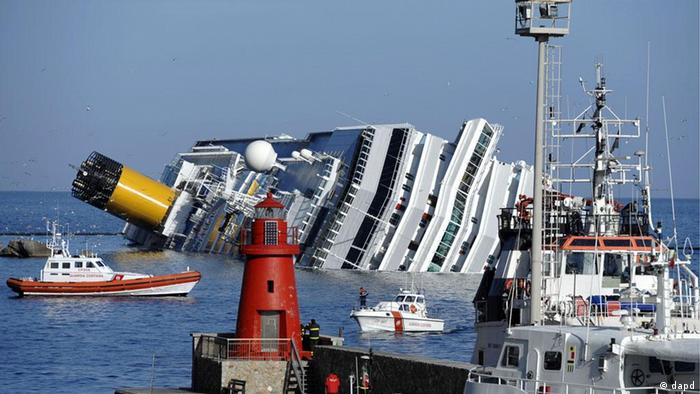
Without propulsive power and no emergency divers resume search of costa concordia power, Costa Concordia moved through inertia and the settings of its rudders, [25] and continued north from Le Scole until well past Giglio Porto. The vessel was then listing to starboard, initially by about 20°, coming to rest by [30] at Punta Gabbianara in about 20 metres [31] of water at an angle of heel of about 70°. Schettino attributed the final grounding of the ship at Punta Gabbianara to his own effort to manoeuvre her there.
Schettino said that, before approaching the island, he turned off the alarm system for Costa Concordia ' s computer navigation system. I had done the move three, four times. Schettino claimed that Costa Cruises managers told him to perform a sail-past salute on the night of the collision. Costa Cruises confirmed that the course taken in was "not a defined [computer programmed] route for passing Giglio".
Passengers were in the dining hall when there was a sudden, loud bang, which a crew member speaking over the intercom ascribed to an "electrical failure". The noise—there was panic, like in a film, dishes crashing to the floor, people running, falling down the stairs and saying ' cazzo ' ", reported a survivor. Those on board said the ship suddenly tilted to the port side.
Half an hour before the abandon-ship order, one crew member was recorded on video telling passengers at a muster station"We have solved the problems we had divers resume search of costa concordia invite everyone to return to their cabins. The president of Costa Cruises, Gianni Onorato, said normal lifeboat evacuation became "almost impossible" because the ship listed so quickly.
Route of Mediterranean cruise from Civitavecchia and back. Arrow: journey on first leg, star: collision. Planned route starting at UTC together with deviation starting at UTC ending off Giglio. Deviation from UTC leading to collision UTC and grounding Divers resume search of costa concordia [59]. After the grounding, passengers and crew were taken ashore from the ship by lifeboats and helicopters or swam to the island, leaving about 40 people missing.
Half of these were later found inside the ship, most of them deceased, divers resume search of costa concordia. In the first contact, divers resume search of costa concordia, made atbetween Italian port officials and Costa Concordia after the impact on the reef, an unidentified officer on board the cruise ship insisted they were suffering only from an electrical "black-out" from a blown electrical generator.
AtSchettino told the Port of Livorno 's harbour master that the ship had taken water through an opening in the port side and requested a tug boat. He began to evacuate the ship divers resume search of costa concordia Schettino's order.
While the vast majority of the ship's multinational personnel held positions that did not require a seaman 's qualifications as they handled services like laundry, cooking, entertainment, cleaning, minding children, and waiting tablesaccording to a senior shipping official, they had received mandatory training in basic safety to be able to help in situations like this.
Although all of them spoke at least basic English, most spoke no Italian. Several passengers asserted that the crew did not help or were untrained in launching the lifeboats. This allegation was denied by the crew, one of whom stated, "The crew members, whether Filipino or Colombians or Indians, tried to the best of our ability to help passengers survive the shipwreck.
Comments by some of the passengers that we were unhelpful have hurt us. We did all we could to avoid catastrophe. According to investigators, Schettino had left the ship by In one telephone call from the Coast Guard to Schettino, Captain Gregorio De Falcoa captain from Livornorepeatedly ordered Schettino to return to the ship from his lifeboat and take charge of the ongoing passenger evacuation.
At one point in the call, De Falco grew so angry at Schettino's stalling that he raised his voice and told Schettino, " Vada a bordo, cazzo! Atan Air Force officer who was lowered on board by helicopter reported that there were still people on board. He and Canessa were "shoulder to shoulder" until Atpassengers were evacuated to the mainland by ferry.
Atthe Air Force officer reported that 40 to 50 people were still on board. Atthe evacuation was noted as "complete" on the Port of Livorno 's Harbour Master log.
Between 14 and 30 Januaryrescue divers searched within the ship for missing people. The head of the coast guard diving team described the conditions inside the ship, still perched on a metre ft ledge, as "disastrous". The search dives were planned as 40 minutes in duration, with sufficient extra compressed air in the scuba tanks in case of emergency. The divers had two headlamps positioned on their helmets because underwater visibility varied from approximately 5 to 60 cm.
In addition, divers marked their route by trailing a line to be used to lead them back out in low visibility and positioned extra emergency air tanks within the ship. On 14 January, divers searched the ship until nightfall. On 16 January, violent waters shifted the ship about 1, divers resume search of costa concordia. On 20 January, the ship began shifting by 1. Gabrielli said, "Our first goal was to find people alive Now we have a single, big goal, and that is that this does not translate into an environmental disaster.
On 28 January, the 17th body, that of a female crew member, was recovered from a submerged part of the vessel. A "special platform" was assembled to facilitate swift recovery of the bodies, [] four of which were recovered.
On 22 February, the recovery was suspended by inclement weather. On 22 March, another five bodies were discovered in a remote section of the ship that was believed to be inside the hull. On 15 Januarythe final two bodies were thought to have been located those of a female passenger and a male crew memberbut they reportedly could not be recovered, because their location near the stern made their recovery inaccessible until the ship could be rotated.
However, divers resume search of costa concordia, the companies performing the refloating operation denied finding any bodies.
The search for the two still missing bodies continued after the ship was uprighted on 17 September On 26 Septemberdivers resume search of costa concordia remains were found near the central part of the ship, where they were last seen. The remains were subjected to DNA testing in order to determine their identity. On 23 Octoberit was announced that the search for the missing while the wreck was still in the water was completed as far as was technically possible. Depending on the outcome of identification divers resume search of costa concordia of divers resume search of costa concordia already found, it was stated that further search activities might divers resume search of costa concordia conducted in the wreck for the missing crew member Russel Rebello after it has been removed from the water.
On 6 and 7 Augustdivers found human remains on the wreck which was then moored in the port of Genoa, divers resume search of costa concordia. Numerous reports of the wreck site being infiltrated by looters and souvenir hunters were made following the disaster. Items stolen from the wreck include the ship's bell[] cash registers, jewellery, furniture, artwork and various assorted smaller items.
Sources at Costa Crociere indicated that the thieves may have gained access to the interior of the ship via entrances cut by search and rescue teams. Authorities banned all private boats from Giglio Porto and excluded them from a one-nautical-mile 1, m non-navigation zone around the ship. Poor weather conditions could have caused a spill of oil from the ship. On 7 February, Civil Protection director Franco Gabrielli told the Italian Senate that the waters were not completely clear of oil but are "within the legal limits".
In a first step to prevent pollution of the shore and assist in a refloat the ship, her oil and fuel tanks were emptied, divers resume search of costa concordia. As part of the recovery effort a group of about giant fan mussels Pinna nobilis were manually relocated to a nearby area due to the threat posed by subsequent engineering work. Isola del Giglio lies within the Pelagos Sanctuary for Mediterranean Marine Mammals[] one of the Specially Protected Areas of Mediterranean Importance.
It is a popular scuba diving destination, with tourism being its leading business. Island residents were concerned that the wreck would have a negative impact on tourism and by extension the island's economy due to its effect on the view in the area. If the oil pollutes the coast, we're ruined. EMSA -contracted stand-by oil spill response vessel Salina Bay arrived divers resume search of costa concordia the site of Costa Concordia on 28 January and remained on station as a precautionary measure during the fuel removal operation.
He also promised to minimise harm to their divers resume search of costa concordia businesses. The wreck came to rest on a rock ledge and there were concerns that she might slide into deeper water.
The stability and deformation of the ship was monitored by satellite imagery and surface-based instruments. The more time passes, the weaker the hull becomes. We cannot guarantee that it has not been compromised already. On 16 February, Civil Protection director Gabrielli "confirmed that the data registered is absent of anomalies".
Another report based on sonar and laser measurements, and an ISPRA underwater video, [] indicated that the ship might collapse in its midsection because its weight was not supported between the rock spur supporting the bow and the rock spur supporting the stern, and said at the time that both of those rocks had "now started crumbling dramatically". Civil Protection director Gabrielli stated that report was reassuring in that "It shows that a part of the seabed has got into the hull, basically increasing the ship'[s] stability.
All operations planned for the wreck, including defuelling, were conducted jointly by Costa Cruises and the Concordia Emergency Commissioner's Office.
Hoses were then attached to the valves and as the oil, warmed to make it less viscous, was pumped out of the upper hose and into a nearby ship, it was replaced with sea water pumped in through the lower hose to fill the space, so as not to affect the ship's balance, a technique known as "hot-tapping". The operation from June onwards was delineated by Costa's Cristiano De Musso, Head of Corporate Communications, according to the following plan: []. By 20 Februarythe tanks in the forward part of the ship, which had held about two-thirds of the fuel, had been emptied, [] but the following day defuelling was suspended because of poor weather conditions.
With defuelling complete, removal of the wreck began. The CEO of Costa stated divers resume search of costa concordia after the breaches in the hull were sealed, [] the ship could be refloated, with difficulty, by giant inflatable buoys and then towed away.
By 12 AprilCosta Crociere had two consortia in mind: Smit and NERI, or Titan Salvage and Micoperi. On 21 April, it was announced that Florida-based marine salvage and wreck removal company Titan, [] with its partner company Micoperi, an Italian firm specialising in undersea engineering solutions, had been awarded the contract to refloat and tow Costa Concordia to a port on the Italian mainland.
Steel sponsons are attached to the port side and partially filled with water, divers resume search of costa concordia. Preparatory work consisted of building an underwater metal platform and artificial seabed made of sand and cement on the downhill side of the wreck and welding sponsons to the side of the ship above the surface. In Junea barge was put in place, and the removal of her radar, waterslide and funnel began before stabilisation of the ship to prevent further slippage down the sloped seabed.
The operation to right the ship and free her from the rocks began on 16 Septemberbut started late due to bad weather. Preparing for righting, July On the left are the strand jacks used to pull the cables mounted on the tops of the retaining turrets.
Inside Costa Concordia: New diver's footage
, time: 1:01Archives - Los Angeles Times
Up to the minute maritime business and corporate news from one of the oldest and most esteemed industry newsletters The latest travel information, deals, guides and reviews from USA TODAY Travel Search. Close. U.S. Department of State The Lessons of Freedom and Our Future

No comments:
Post a Comment